Gallery
Framework Architecture
Framework Architecture
Core Claim:
The central claim of the PII Framework Architecture is that responsible institutional action requires disciplined interpretation, structured classification, governed power, and preserved capacity for correction.
Meaning, representation, ontology, admissibility, power, institutional process, technological capability and governance are not isolated domains. They operate within an interconnected analytical architecture governed by evidential thresholds, responsibility, constraint and correction.
The architecture examines how:
signals become interpretations;interpretations become classifications;representations acquire standing;power becomes available for action;action creates consequential transitions;and institutions preserve—or lose—the capacity to correct what follows.
Without this structure, signals can be mistaken for reality, representations for facts, authority for validity, capability for admissibility, and institutional persistence for successful governance.
With it, complex conditions can be examined without prematurely collapsing interpretation, classification, authority and action into a single decision.
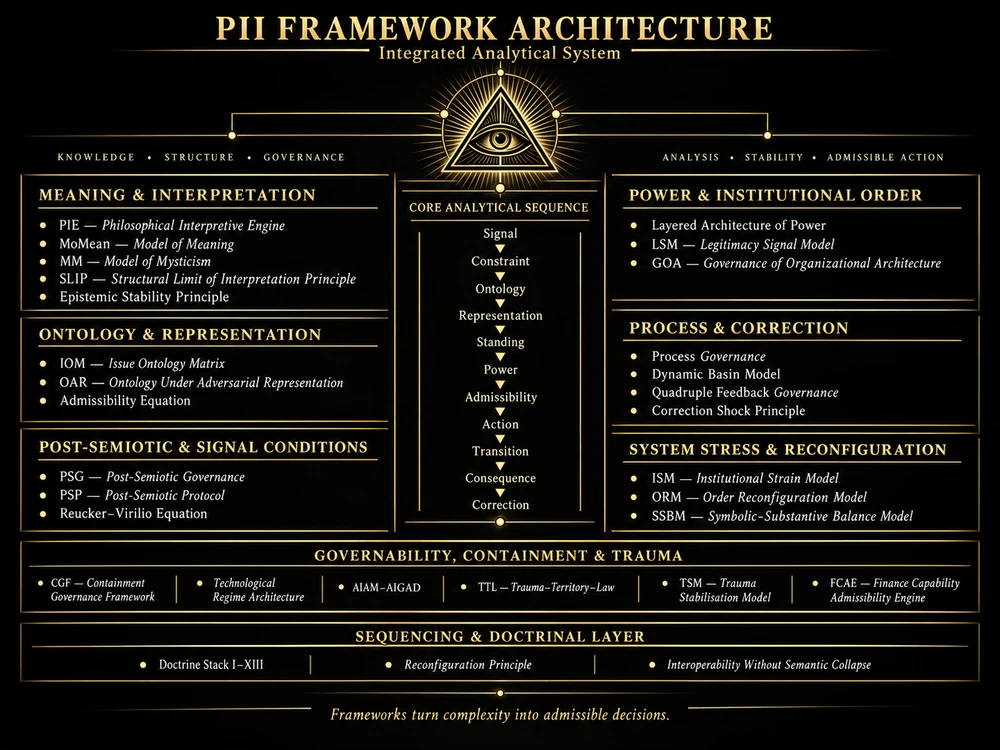
The Framework Architecture
PII’s Framework Architecture connects several analytical layers.
At its interpretive core is the Philosophical Interpretive Engine (PIE):
Signal → Constraint → Ontology → Admissibility → Action
PIE establishes that signals do not become legitimate grounds for action simply because they are visible or urgent. Interpretation must be constrained, the underlying condition must be classified, and proposed action must pass an admissibility threshold.
Around this core, additional PII architectures govern the transitions through which institutional reality is formed.
Meaning and Interpretation
The Model of Meaning (MoMean), Model of Mysticism (MM), SLIP, the Epistemic Stability Principle, and related interpretive frameworks examine how meaning is formed, stabilised, transformed and constrained.
They establish the conditions under which interpretation remains supportable rather than expanding beyond available evidence.
Ontology, Representation, and Standing
The Issue Ontology Matrix (IOM) examines what kind of problem is actually present.
Ontology Under Adversarial Representation (OAR) extends this problem by examining how reality reaches institutions through representations—expert, legal, administrative, synthetic, machine-mediated or otherwise compressed.
The resulting governance sequence can be expressed as:
Target → Representation → Interpretation → Standing → Admissibility → Action → Consequence → Correction
The central discipline is that:
Representation is not reality. Standing must be governed.
Power Architecture
The Layered Architecture of Power (LAP) examines how institutional power develops through eleven interconnected layers:
Perception → Ontology → Knowledge → Position → Resources → Dependency → Alternatives → Influence → Operation → Stabilisation → Correction
Power therefore begins before the visible decision.
It is already operating through what becomes visible, whose knowledge receives standing, which resources are controlled, which dependencies form and which alternatives remain practically available.
LAP consequently introduces a further distinction:
Power determines what can be done.Governance determines what may be done.Admissible governance determines when power may be converted into action.
Process Governance
Process Governance adds the temporal dimension.
Institutions inherit conditions from previous decisions. They interpret those conditions, make selections, form determinations, pass through consequential transitions and reproduce new conditions for future actors.
Its working grammar is:
Inheritance → Selection → Integration → Determination → Transition → Reproduction
Process Governance therefore asks not only whether an action is admissible now, but:
What conditions will this action create for those who must govern next?
Each consequential transition must be governed anew.
Governance Dynamics and Correction
The Dynamic Basin Model, Quadruple Feedback Governance, Institutional Strain Model (ISM), Order Reconfiguration Model (ORM), Legitimacy Signal Model (LSM) and Correction Shock Model examine what happens when institutional conditions become stabilised, stressed or resistant to correction.
A central principle is:
The longer a governance contradiction is stabilised, the greater the shock required to correct it.
Correction is therefore not an afterthought.
It is part of the architecture of legitimate institutional capacity.
Governance Under Constraint
The Containment Governance Framework (CGF) and Symbolic–Substantive Balance Model (SSBM) examine systems operating under constrained design capacity, institutional pressure and high symbolic intensity.
These frameworks distinguish adaptive stabilisation from retrenchment, drift, symbolic substitution and more fundamental structural transformation.
Technological Regimes and Computational Governance
The Technological Regime Architecture examines how technologies become embedded within infrastructure, standards, expertise, routines and institutional dependencies.
PII distinguishes:
technological capability ≠ technological governability
A system may be highly capable while the institution using it has limited practical capacity to monitor, modify, recover, reverse or exit from it.
AIAM–AIGAD and related AI governance work extend this analysis to computational systems whose classifications or outputs may acquire institutional standing.
Post-Semiotic Conditions
Post-Semiotic Governance (PSG) and the Post-Semiotic Protocol (PSP) address environments in which interpretation and meaning continue to circulate but no longer reliably constrain consequential action.
These frameworks preserve analytical discipline where symbolic intensity, signal velocity or institutional pressure begin to overwhelm ordinary interpretive processes.
Integrated System
The PII Framework Architecture is therefore not a collection of independent models.
It is an integrated analytical system connecting:
Meaning
↓
Interpretation
↓
Representation
↓
Ontology
↓
Standing
↓
Power
↓
Admissibility
↓
Action
↓
Transition
↓
Consequence
↓
Correction
↓
Institutional Inheritance
↓
Interpretation
↓
Representation
↓
Ontology
↓
Standing
↓
Power
↓
Admissibility
↓
Action
↓
Transition
↓
Consequence
↓
Correction
↓
Institutional Inheritance
Different PII frameworks operate at different points in this sequence.
The objective is not to force every problem through a single model.
It is to preserve the distinctions required for complex institutional reasoning while allowing frameworks to interoperate without semantic collapse.
Operational Application
The architecture becomes especially important under conditions of live institutional pressure.
When signals accelerate, uncertainty increases and demands for action intensify, institutions may begin compressing analytical stages.
A signal becomes a conclusion.A representation becomes reality.A classification becomes authority.Authority becomes permission.Capability becomes justification.Action occurs before correction has been designed.
PII frameworks intervene by restoring analytical separation.
They ask:
What is actually known?What has merely been represented?What kind of condition is present?Who has authority?Who possesses power?Which alternatives remain?What action is admissible?What transition will follow?Who inherits its consequences?How can the institution correct itself if its interpretation proves wrong?
This is the operational function of the Framework Architecture.
It enables complex institutional action while preserving the possibility of revision.
Integrated Framework System
The architecture now includes, among others:
- PIE — Philosophical Interpretive Engine
- MoMean — Model of Meaning
- MM — Model of Mysticism
- IOM — Issue Ontology Matrix
- SLIP — Structural Limit of Interpretation Principle
- OAR — Ontology Under Adversarial Representation
- LAP — Layered Architecture of Power
- Process Governance Architecture
- GOA — Governance of Organizational Architecture
- Admissibility Verification Model
- CGF — Containment Governance Framework
- LSM — Legitimacy Signal Model
- ISM — Institutional Strain Model
- ORM — Order Reconfiguration Model
- SSBM — Symbolic–Substantive Balance Model
- Dynamic Basin Model
- Correction Shock Model
- Quadruple Feedback Governance
- PSG — Post-Semiotic Governance
- PSP — Post-Semiotic Protocol
- Technological Regime Architecture
- Technological Governability
- AIAM–AIGAD
- TTL — Trauma–Territory–Law
- TSM — Trauma Stabilisation Model
- Reucker–Virilio Equation
- Literary Intelligence
- FCAE — Finance Capability Admissibility Engine
Closing Position
The Framework Architecture establishes Philosophical Intelligence as a disciplined method for moving from complexity toward consequential action without allowing interpretation, representation, authority or power to outrun their justification.
Its purpose is not merely to produce explanations.
It is to ensure that the transitions from interpretation to classification, from classification to power, and from power to action remain visible, governable and correctable.
Frameworks turn complexity into admissible decisions.